After this chapter, you should be able to
- Identify credible shallow-foundation limit states.
- Explain the components of a classical bearing-resistance model.
- Separate gross, net, ultimate and allowable terminology.
- Integrate settlement and groundwater checks with resistance.
- Define construction verification and bearing-level hold points.
Engineering context and evidenceSource §Lesson 07 · Engineering context and evidence · FHWA GEC 6 · NHI-06-089 Chapter 8
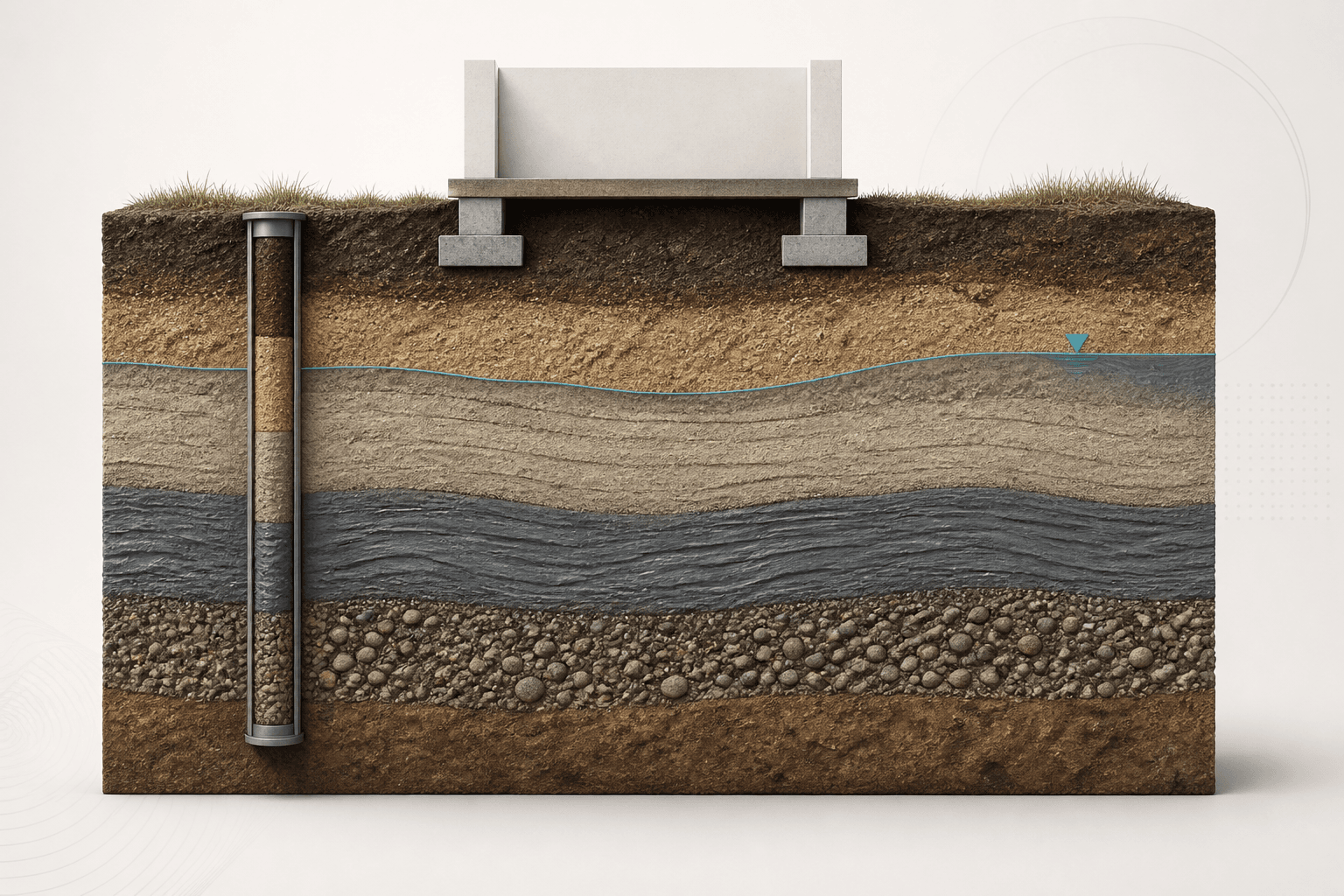
A shallow foundation transfers structural actions into near-surface ground through contact pressure and confinement. Design must consider bearing failure, sliding, overturning, total and differential settlement, groundwater, adjacent excavations and construction feasibility. A single bearing-capacity number does not constitute a foundation design.
Core principles and terminologySource §Lesson 07 · Core principles and terminology · FHWA GEC 6 · NHI-06-089 Chapter 8
Resistance depends on foundation geometry and embedment, load inclination and eccentricity, soil strength, groundwater and the selected analytical method. Settlement may govern well before an ultimate mechanism is approached. Excavation can loosen granular soils, soften fine soils or expose unexpected fill, changing the assumed bearing condition.
- Ultimate bearing resistance
- Calculated limiting resistance for the stated mechanism and method before design or safety factors.
- Net foundation pressure
- Foundation-induced pressure relative to the removed or pre-existing overburden convention.
- Effective area
- Reduced plan area used by some methods to represent load eccentricity.
- Serviceability
- Performance criteria including settlement, rotation and effects on the supported structure.
Equations, conventions and valid useSource §Lesson 07 · Equations, conventions and valid use · FHWA GEC 6 · NHI-06-089 Chapter 8
This simplified vertical, centred strip-footing form exposes the three resistance components. Actual methods apply geometry, depth, inclination, groundwater and other factors defined by the governing standard.
This simple homogeneous profile expression uses the appropriate unit weight above foundation level. Layering, groundwater and excavation sequence require a piecewise model.
Engineering workflowSource §Lesson 07 · Engineering workflow · FHWA GEC 6 · NHI-06-089 Chapter 8
- Resolve vertical, horizontal and moment actions into design combinations and foundation contact conditions.
- Set founding level from ground model, frost/scour, services, adjacent assets and constructability.
- Select a resistance method compatible with drainage, parameters, geometry and governing standard.
- Check eccentricity, effective area, sliding, uplift, overturning and relevant global mechanisms.
- Calculate immediate and time-dependent total and differential settlement.
- Assess groundwater, excavation stability, base disturbance and temporary works.
- Specify bearing-level inspection, proof/verification measures, replacement criteria and records.
| Check | Ground input | Output to coordinate |
|---|---|---|
| Bearing resistance | Strength and groundwater | Design resistance and method limits |
| Settlement | Stiffness, compressibility and stress history | Total/differential movement |
| Sliding/eccentricity | Interface and load resultants | Contact area and stability |
| Construction | Excavatability and weather sensitivity | Hold points and remedial detail |
Verified teaching exampleSource §Lesson 07 · Verified teaching example · FHWA GEC 6 · NHI-06-089 Chapter 8
Expose the components of a strip-footing model
For a centred 2.0 m wide strip footing at Df = 1.0 m in a simplified drained cohesionless profile, take φ′ = 30°, γ = 18 kN/m3, c′ = 0, Nq = 18.4 and Nγ = 22.4 from FHWA GEC 6 Table 5-1. Ignore all correction factors for this arithmetic illustration.
- Base surcharge
q = 18×1.0
q = 18 kPa - Surcharge component
qNq = 18×18.4
331.2 kPa - Unit-weight component
0.5×18×2.0×22.4
403.2 kPa - Sum
qult = 0 + 331.2 + 403.2
qult = 734.4 kPa
Result. The uncorrected, source-consistent teaching form gives qult = 734.4 kPa. It is not an allowable pressure or a project design value.
Failure modes and engineering judgementSource §Lesson 07 · Failure modes and engineering judgement · FHWA GEC 6 · NHI-06-089 Chapter 8
- Calling an ultimate gross resistance an allowable net bearing pressure.
- Using bearing factors from one method with correction factors from another.
- Ignoring load eccentricity and contact loss.
- Checking resistance but not differential settlement.
- Pouring concrete on softened, flooded or unverified bearing material.
Key points
- Shallow foundations require resistance, serviceability and constructability checks.
- Terminology and factor format must be explicit.
- Groundwater and bearing-level disturbance can change the assumed model.
- Inspection and response criteria are part of the design evidence chain.
Source references recorded by the supplied chapter
- FHWA-SA-02-054, Geotechnical Engineering Circular No. 6: Shallow Foundations.
- FHWA NHI-06-089, Soils and Foundations Reference Manual, Volume II, Chapter 8.