After this chapter, you should be able to
- Distinguish description, classification and design characterization.
- Calculate plasticity and grading indices.
- Interpret particle-size and Atterberg-limit results together.
- Identify when classification evidence is insufficient.
- Communicate material variability without false precision.
Engineering context and evidenceSource §Lesson 02 · Engineering context and evidence · NHI-06-088 Chapter 4 · NHI-16-072 Chapter 4
Classification creates a consistent language for grouping soils from observed and measured properties. It helps organize evidence and anticipate behaviours, but it does not directly supply strength, stiffness, permeability or compressibility for design. Those properties depend on fabric, density, stress history, structure, saturation and the test path.
Core principles and terminologySource §Lesson 02 · Core principles and terminology · NHI-06-088 Chapter 4 · NHI-16-072 Chapter 4
Coarse-soil descriptions rely strongly on particle-size distribution and fines characteristics; fine-soil descriptions use consistency limits and plasticity response. Representative sampling matters because segregation, oversize particles and disturbance can bias results. Borderline results should be reported as such rather than forced into a confident label.
- Liquid limit, LL
- Water content associated with the adopted liquid-limit test criterion.
- Plastic limit, PL
- Water content at the boundary between plastic and semi-solid response under the test convention.
- Plasticity index, PI
- The numerical range LL − PL over which the soil exhibits plastic behaviour.
- Dₓ
- Particle size for which x percent by mass is finer on the grading curve.
Equations, conventions and valid useSource §Lesson 02 · Equations, conventions and valid use · NHI-06-088 Chapter 4 · NHI-16-072 Chapter 4
LL and PL are water contents expressed using the same percentage basis. Check repeatability and sample preparation before interpretation.
Use consistent particle-size units and only a grading curve that reliably defines both intercepts.
This grading-shape index supports classification; it is not a permeability or compaction equation.
Engineering workflowSource §Lesson 02 · Engineering workflow · NHI-06-088 Chapter 4 · NHI-16-072 Chapter 4
- Check sample identity, depth, recovery, disturbance and representativeness.
- Describe colour, grading, plasticity, structure, inclusions and condition using the project system.
- Select particle-size and consistency tests appropriate to the material.
- Plot and quality-check the grading curve; calculate only indices supported by valid intercepts.
- Compare visual description and laboratory classification; investigate contradictions.
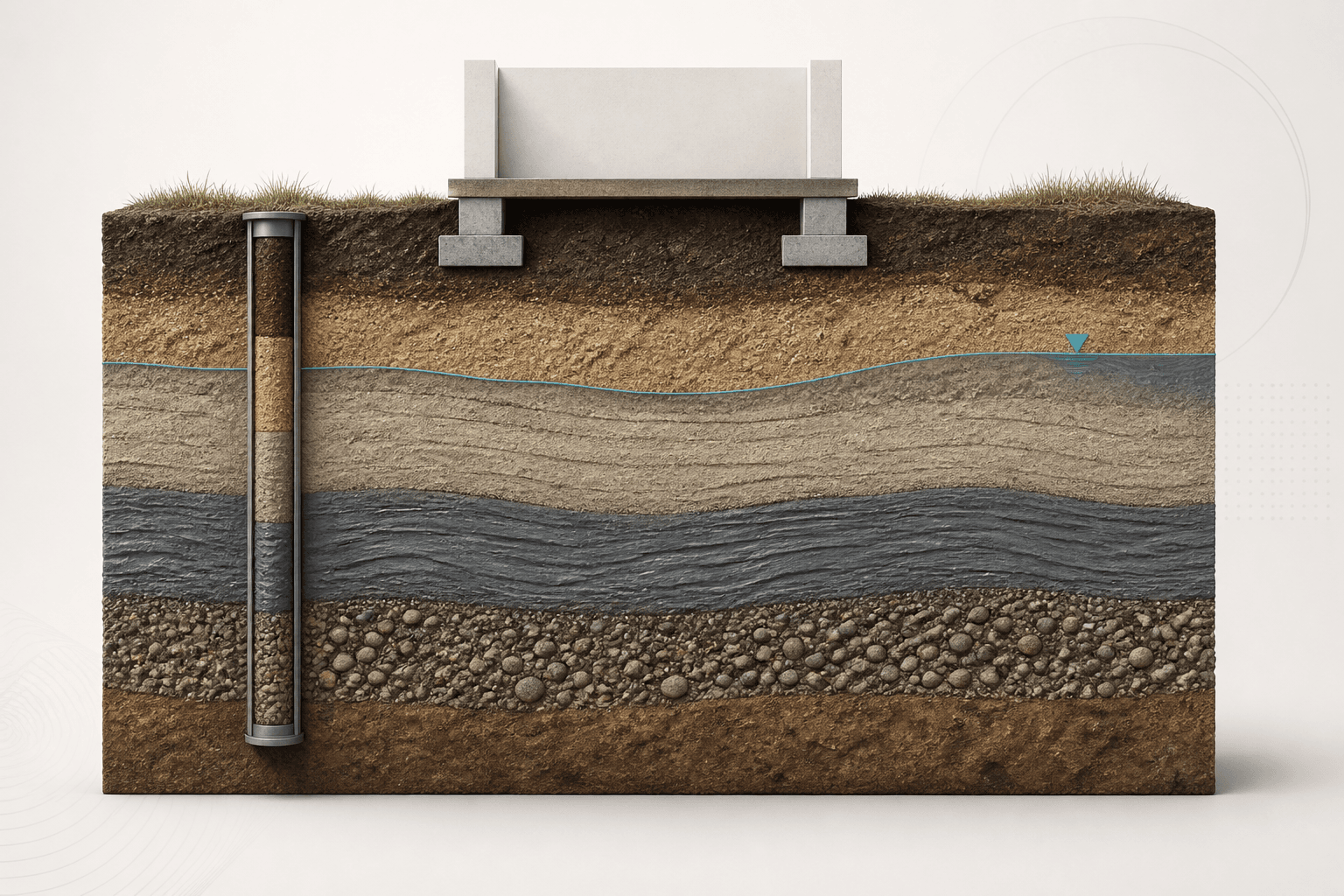
- Map variability by stratum and location rather than selecting one site-wide label.
- Obtain performance parameters with tests and correlations whose applicability is documented.
| Observation or index | Supports | Does not establish alone |
|---|---|---|
| Particle-size distribution | Grading and coarse/fine fractions | Hydraulic conductivity |
| LL, PL and PI | Consistency and plasticity classification | Undrained shear strength |
| Natural water content | Current sample condition | Permanent groundwater state |
| Soil group symbol | Consistent communication | Foundation bearing resistance |
Verified teaching exampleSource §Lesson 02 · Verified teaching example · NHI-06-088 Chapter 4 · NHI-16-072 Chapter 4
Calculate indices without over-classifying
A specimen has LL = 42%, PL = 24%, D10 = 0.12 mm, D30 = 0.26 mm and D60 = 0.60 mm. Calculate PI, Cu and Cc.
- Plasticity
PI = 42 − 24
PI = 18% - Uniformity
Cu = 0.60 / 0.12
Cu = 5.00 - Curvature
Cc = 0.262 / (0.12 × 0.60)
Cc = 0.94
Result. PI = 18%, Cu = 5.00 and Cc = 0.94. A complete classification still needs fines percentage, test method and the governing classification criteria.
Failure modes and engineering judgementSource §Lesson 02 · Failure modes and engineering judgement · NHI-06-088 Chapter 4 · NHI-16-072 Chapter 4
- Assigning a classification from a photograph or visual estimate alone.
- Using D-values read from an extrapolated grading curve.
- Calling classification thresholds universal without naming the system.
- Treating PI as a direct measure of strength or swelling pressure.
- Ignoring organic content, cementation, sensitivity or particle breakage.
Key points
- Classification is a language for evidence, not a substitute for design characterization.
- PI, Cu and Cc are meaningful only with sound tests and stated conventions.
- Borderline and heterogeneous materials require transparent reporting.
- Performance parameters need separate, applicable evidence.
Source references recorded by the supplied chapter
- FHWA NHI-06-088, Soils and Foundations Reference Manual, Volume I, Chapter 4.
- FHWA NHI-16-072, Geotechnical Site Characterization, field and laboratory characterization chapters.